AI vs Human Billers for Denial Appeals
Hybrid teams of AI and human billers outperform either alone on denial appeals.
Denial rates aren't holding steady, they're climbing fast. Experian Health's State of Claims research found 30% of providers reporting denial rates above 10% in 2022. By 2024 that number hit 38%. By 2025, 41%. The reason isn't more paperwork errors or sicker patients. It's that insurers now run AI systems that process claims in bulk, flag anything that doesn't match a predetermined pattern, and reject it, often without a physician ever looking at the file.
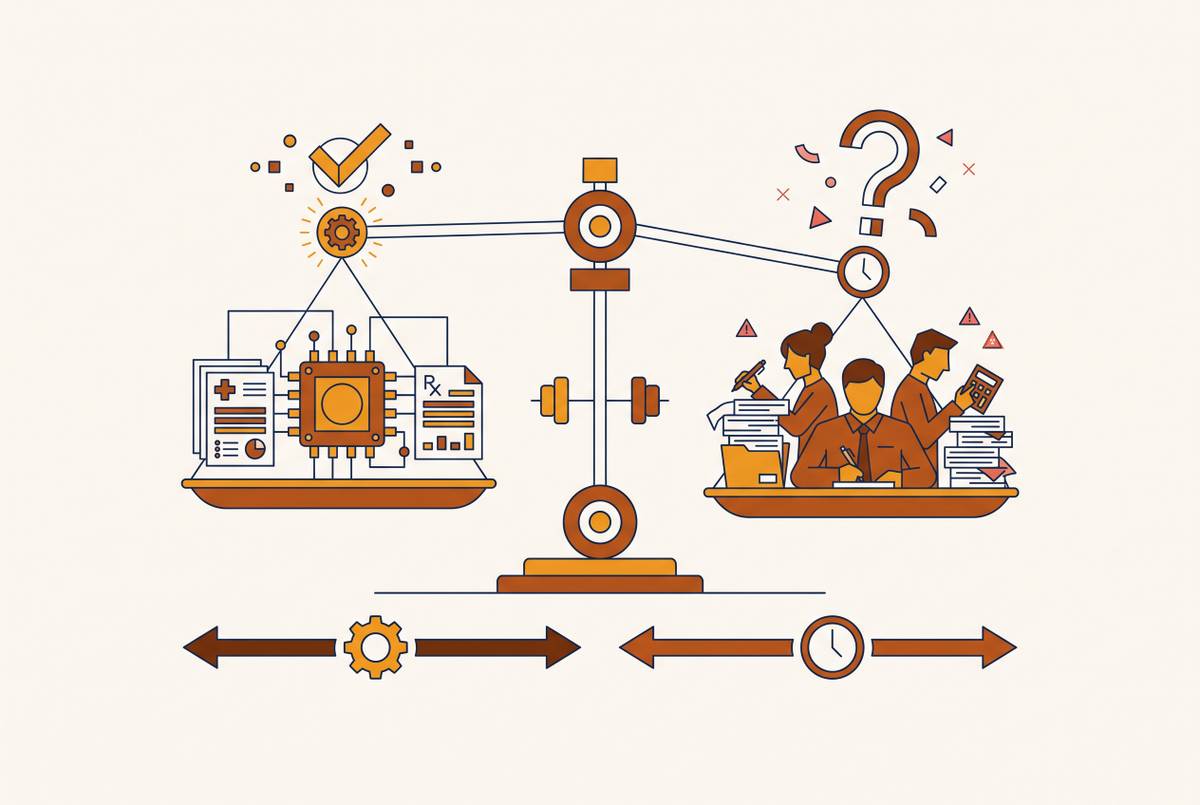
Neither AI alone nor a human biller alone is more effective; the documented advantage belongs to a hybrid operation that uses both. AI systems can screen every denial the moment it arrives, draft appeal language, and flag deadline risk at a volume no billing staff can match manually, while platforms like Claimable report success rates above 80% and Counterforce Health's tool comes in around 70%. But AI hallucinates, lacks the payer-specific behavioral memory an experienced biller builds over years, and cannot catch the clinical mismatches or regulatory angles, such as California's SB 1120 requirement for real physician review, that turn a marginal appeal into a winning one. The split that works: AI handles throughput so nothing ages past a deadline, and human billers review every draft for accuracy, work the exception cases, and manage escalations.
Cigna's own numbers, reported by AAPC in Healthcare Business Monthly in February 2026, put a fine point on it: an algorithm reviewed roughly 300,000 denials over two months, spending about 1.2 seconds on each one. That's not a review. That's a filter. And physicians have noticed: an AMA survey from February 2025 found 61% of doctors blaming AI specifically for the rise in prior authorization denials over the preceding five years.
The mechanics matter here, because the effect on a practice is not abstract. Every denied claim requires someone to pull the file, figure out why it was rejected, and rework it, on top of a workload no one budgeted for this volume of denials. Industry reporting suggests a large share of denied claims eventually get paid anyway, which suggests payers are using the initial denial less as a final answer and more as a delay tactic. The cost of that delay doesn't land on the insurer. It lands on the provider, in cash flow gaps and staff hours that were never on the schedule. Once denials arrive faster than a billing team can read them, the only real question is how a practice responds with technology of its own, not whether it should.
Why the appeal window is both the highest-leverage moment and the most neglected one
Almost nobody appeals. KFF data shows fewer than 1% of denied claims get appealed by patients, and a 2025 guide from Counterforce Health puts marketplace appeal rates even lower, somewhere around 0.3% to 0.4%. That's a strange number given what happens when people actually do appeal: industry data shows first-level provider appeals succeed more than half the time, and Medicare Advantage appeals get fully or partially overturned in roughly three out of four cases.
So the gap isn't about whether appeals work. It's about whether anyone files them. Writing a real, payer-specific appeal, one that cites the right policy language and matches the clinical record to the denial reason, takes a biller 30 to 60 minutes per claim. At current denial volumes, that math doesn't close. Staff either burn hours they don't have or the claim ages past the point of no return, since aging claims collect at sharply lower rates and appeal deadlines don't bend for a backlog.
The Cigna case makes the stakes concrete from the other side. AAPC reported a 90% reversal rate on the claims that actually got appealed, meaning the algorithm was wrong nearly nine times out of ten. Most of those wrong denials never got challenged. They just stood, not because the clinical case was weak, but because nobody had the time to write the letter. That's the entire argument for treating the appeal stage as the place where a practice recovers the most money for the least clinical risk, provided it can move at the pace the denials require.
What AI-assisted appeal tools actually do, and where they produce documented results
Counter-AI appeal tools work by reading the denial's stated rationale, checking it against the patient's clinical documentation and the payer's own policy language, then drafting a response formatted the way an AI reviewer is trained to approve. Speed is the whole point. The practical advantage is faster resolution than manual drafting, which is the difference between responding to a wave of denials and drowning in one.
A few examples show what this looks like when it's working. Counterforce Health, a North Carolina startup, has its AI assistant read denial letters, pull the patient's policy and relevant outside medical research, and draft a customized appeal, free of charge; mdrevenuegroup.com has reported its success rate at 70%. Claimable, founded in 2024 by physician Warris Bokhari and backed by Mark Cuban, automates appeals across more than 85 medications, covering conditions from migraines to rheumatologic disease, and reports success rates above 80%. Mayo Clinic runs an AI bot that generates appeal letters straight from specific denial codes, alongside separate bots that handle claim status checks, close out duplicate denials automatically, and track prior authorizations, according to HFMA. Sheer Health, a three-year-old company, connects directly to a patient's insurance account and uses a mix of AI and human staff to answer coverage questions for free, offering tiered support depending on the complexity of a patient's situation.
Some of this value shows up before a claim is even denied. Machine learning models trained on a practice's own claims history can flag likely errors before submission, and the best platforms now hold clean claim rates well above industry average, with top performers pushing toward 98%. Generative AI is also taking on the harder interpretive work: reading shifting payer policy language, summarizing what counts as medical necessity for a given plan, and tailoring appeal language to how a specific payer's reviewers tend to respond.
Here's the strange part. Experian Health's 2025 survey found 69% of providers using AI say it's already reduced denials or improved resubmission success, and 67% think it could improve the claims process generally. Yet only 14% of providers actually use AI for denial reduction today. That gap between belief and adoption is close to the entire opportunity sitting in front of the industry right now.
Where AI-only appeals break down, and what a poorly drafted appeal actually costs
AI hallucinates, and appeal letters are not a forgiving place for it to happen. Carmel Shachar of Harvard Law School warned in Stateline reporting that AI tools carry real risks in this context, and most billing staff have no easy way to catch errors before they go out the door.
A bad appeal isn't a wash, it's a loss. Send a letter with a clinical mismatch or a factual error, and it can close the appeal window entirely, weaken the record if the case ever reaches external review, and weaken the practice's position if the case ever reaches external review. Speed without accuracy just produces more losing appeals instead of fewer denials.
Three things sit outside what any current AI system can carry on its own. The first is payer-specific behavioral knowledge: knowing that a particular insurer denies a given CPT code on first pass but pays it on the second submission with one specific addendum attached. That's not a pattern an algorithm learns from a dataset, it's institutional memory built by someone who's fought that payer before. The second is clinical judgment: figuring out which parts of a patient's chart will actually persuade a reviewer on this specific denial reason requires reading the case, not matching a code to a template. The third is strategy: deciding when to escalate from an internal appeal to an independent external review, and how to frame that escalation, is a human call that depends on the payer, the dollar amount, and the deadline all at once.
Shachar's warning about getting on "an AI-enabled treadmill that just speeds up" applies directly at the practice level. None of this argues against using AI in appeals. It argues that the draft has to be right before it's fast, because a human or AI reviewer on the payer's side is going to scrutinize it either way.
What human billers supply that no current AI system replicates
Experienced billers carry something no training dataset holds: a working memory of how individual payers actually behave. Which denial codes are boilerplate and which are real. Which documentation gets a claim paid on resubmission. Which adjusters respond to a phone call and which only respond to a formal escalation. None of that lives in a model, it lives in a person's head, built claim by claim over years.
That knowledge compounds, and most practices throw it away constantly. A biller who's worked a specific payer's denials for three years produces a fundamentally different appeal success rate than one who started last month, and every time that biller leaves, the practice starts the clock over from zero.
Humans also read cases in a way AI still doesn't. A biller can look at a denial reason next to the actual chart and notice the two don't match, then build the entire appeal around that discrepancy. AI matches codes to templates. People catch the mismatch a code can't see.
Then there's escalation judgment, and it's getting more complicated by the month. California's SB 1120, signed September 28, 2024 and effective January 1, 2025, along with Texas's own approach adopted in June 2025, have started changing the legal ground under AI-driven denials, according to AAPC reporting. Knowing those rules exist, and knowing how to build them into an appeal, is exactly the kind of real-time regulatory awareness a human tracks and a static tool doesn't. With 41% of providers now facing denial rates above 10%, that expertise has to be deployed where it counts most, not spread thin across every single claim.
Is AI or a human biller more effective for handling insurance claim denials?
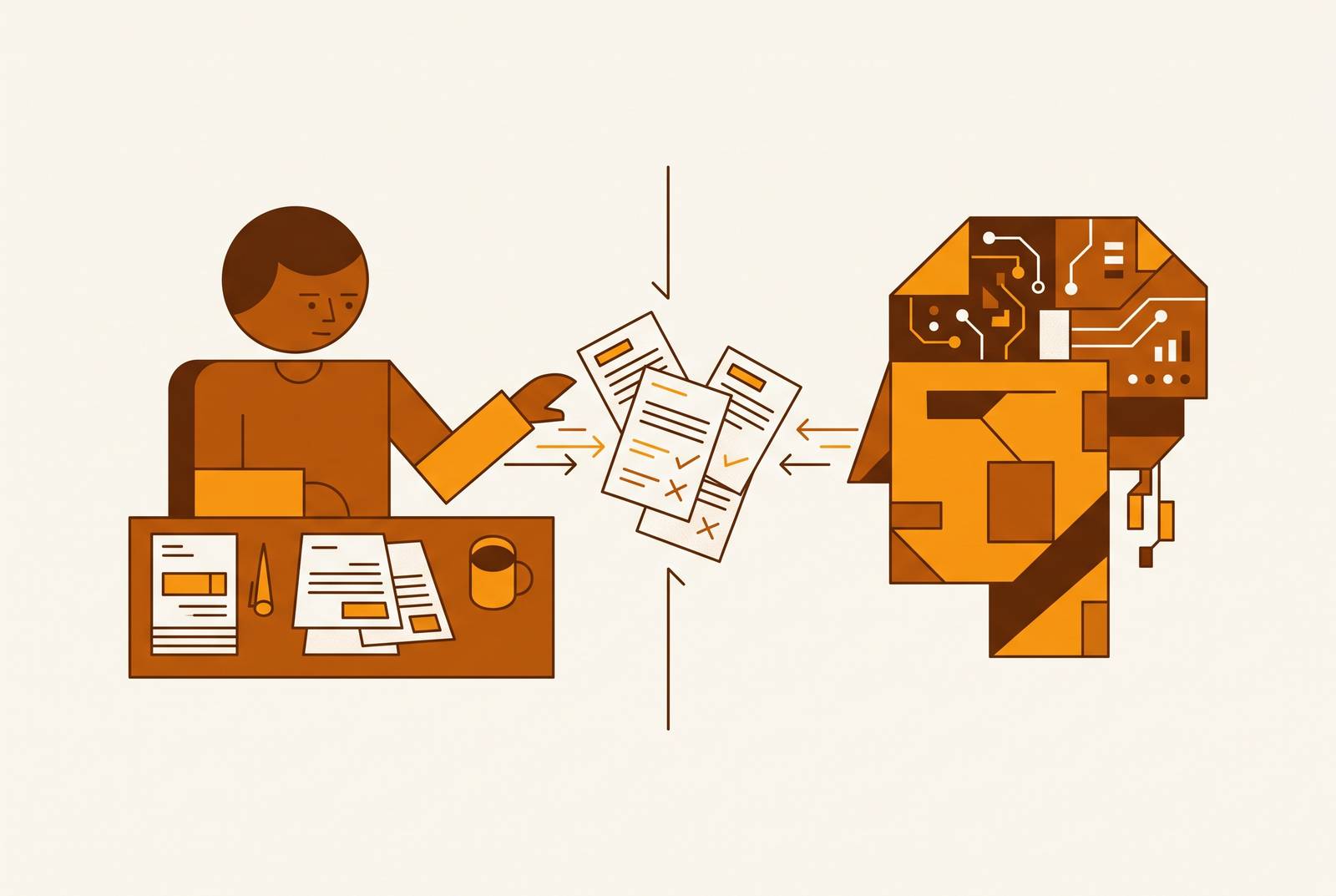
The split is specific. AI screens every denial the moment it lands, sorts it by reason and payer, checks it against the documentation on file, drafts the appeal language, flags the deadline, and surfaces patterns across the whole pile of denials a practice is sitting on. Human billers then review those drafts for clinical accuracy and payer fit, take on the cases that need judgment calls, manage escalations, and catch the hallucinations before anything gets mailed.
Neither side does the other's job well. AI keeps nothing from aging silently past a deadline. Humans keep the appeals that go out from being wrong. At the volumes practices are dealing with now, dropping either half of that equation breaks the whole thing.
The numbers show exactly how much room there is to close. KFF data puts the Medicare Advantage appeal rate at around 11.5%, yet an OIG report found historical overturn rates near 75% when appeals were actually filed, a figure KFF's more recent numbers put above 80%. That gap between what gets appealed and what would win if it were appealed is the entire job of a hybrid model: close it systematically, not case by case when someone happens to have time.
There's a feedback loop worth naming here too. When AI flags a sudden spike in denials tied to one code from one payer, that's the signal for a human biller to go find out whether the payer quietly changed its policy. Neither side generates that insight alone. That division of labor — AI for volume, human staff for the harder escalated cases — is the model a number of emerging platforms are building toward.
None of this matters if the AI output lives somewhere staff have to remember to check. A tool that requires a separate login outside the practice's existing billing workflow gets used for a week and then ignored. The same logic that pushes a clean claim rate toward top-performer benchmarks, catching errors before a human ever looks at the claim, applies just as much on the appeals side of the process.
What the regulatory environment is doing to the payer side, and why that changes the calculus now
California moved first. SB 1120, signed September 28, 2024 and effective January 1, 2025, bars insurers from using AI or algorithms as the sole or partial basis for a medical necessity determination, requires a licensed physician to actually review the patient's record, and gives providers the right to demand proof that review happened after a denial comes through. Texas followed in June 2025 with its own approach, and Arizona, Maryland, and Nebraska have also restricted AI as the sole decisionmaker in prior authorization or medical necessity denials, according to Stateline's November 2025 reporting.
The pace is picking up. Manatt tracked more than a dozen states passing AI health care regulations in 2025 alone, with Massachusetts and New York expected to join next, per AAPC's February 2026 coverage. And the effect isn't just procedural. Research published in JAMA Health Forum found that states with stricter rules on algorithmic denials saw appeal success rates run 23% higher than in states without them.
That has a direct operational meaning. In a state with an SB 1120-style law on the books, a denial issued after January 1, 2025 that can't be shown to have involved real physician review is potentially challengeable on those grounds alone, regardless of the underlying clinical question. Catching that requires someone tracking the regulatory landscape closely enough to know it applies, and building it into the appeal. AI doesn't know to look for it unless it's told to.
Payers are moving too, at least on paper. Close to 50 insurers made voluntary commitments in June 2025 to cut back on prior authorization requirements, and a later survey from AHIP and the Blue Cross Blue Shield Association, run in April 2026, found insurers had eliminated 11% of those requirements overall, with cuts above 15% for Medicare Advantage plans specifically. That's real movement on future prior authorization volume. It does nothing for the claims already sitting in a denial queue today, which is exactly where the appeals strategy still has to do the work.
What to look for in a denial appeals operation that combines both effectively
The right question isn't whether a billing operation uses AI. Almost everyone claims that now. The real question is what happens after the AI flags a denial, who looks at it, and what they're equipped to do with it.
A handful of things separate an operation that's actually built for this from one that just bought a tool. Denials get worked the day they arrive, not batched into a weekly pile, because every day in queue is a day closer to a deadline that doesn't move. AI classification and draft generation turn that 30-to-60-minute manual appeal into something a biller reviews and approves in a few minutes instead of writing from scratch. Billers with real, specific payer experience check every AI draft for clinical accuracy before it goes out, not after. Pattern monitoring flags a denial spike by payer or code fast enough that someone notices a policy shift before it costs another hundred claims. Clear escalation rules decide when a case moves from internal appeal to external review, based on the deadline and the dollar amount, not on whoever happens to pick up the file. And all of it lives inside the practice's existing EMR and clearinghouse setup, because a system that needs a separate login is a system nobody checks by Friday.
The benchmarks are not mysterious. A denial rate under 5%, a clean claim rate at 95% or higher, AR days under 40 by MGMA's standard with the strongest performers under 35, and AR over 90 days held below 10% of total receivables, per HFMA. An operation built to hit those numbers runs AI pattern recognition on every denial that comes in, has billers with real institutional knowledge of specific payers working the exceptions the AI surfaces, and plugs directly into the practice's existing workflow instead of asking it to build a new one. That combination is what actually closes the gap between the roughly one in ten denials that get appealed today and the far larger share that would win if someone had the time to write the letter.