AI Medical Billing Accuracy Compared to In-House Staff
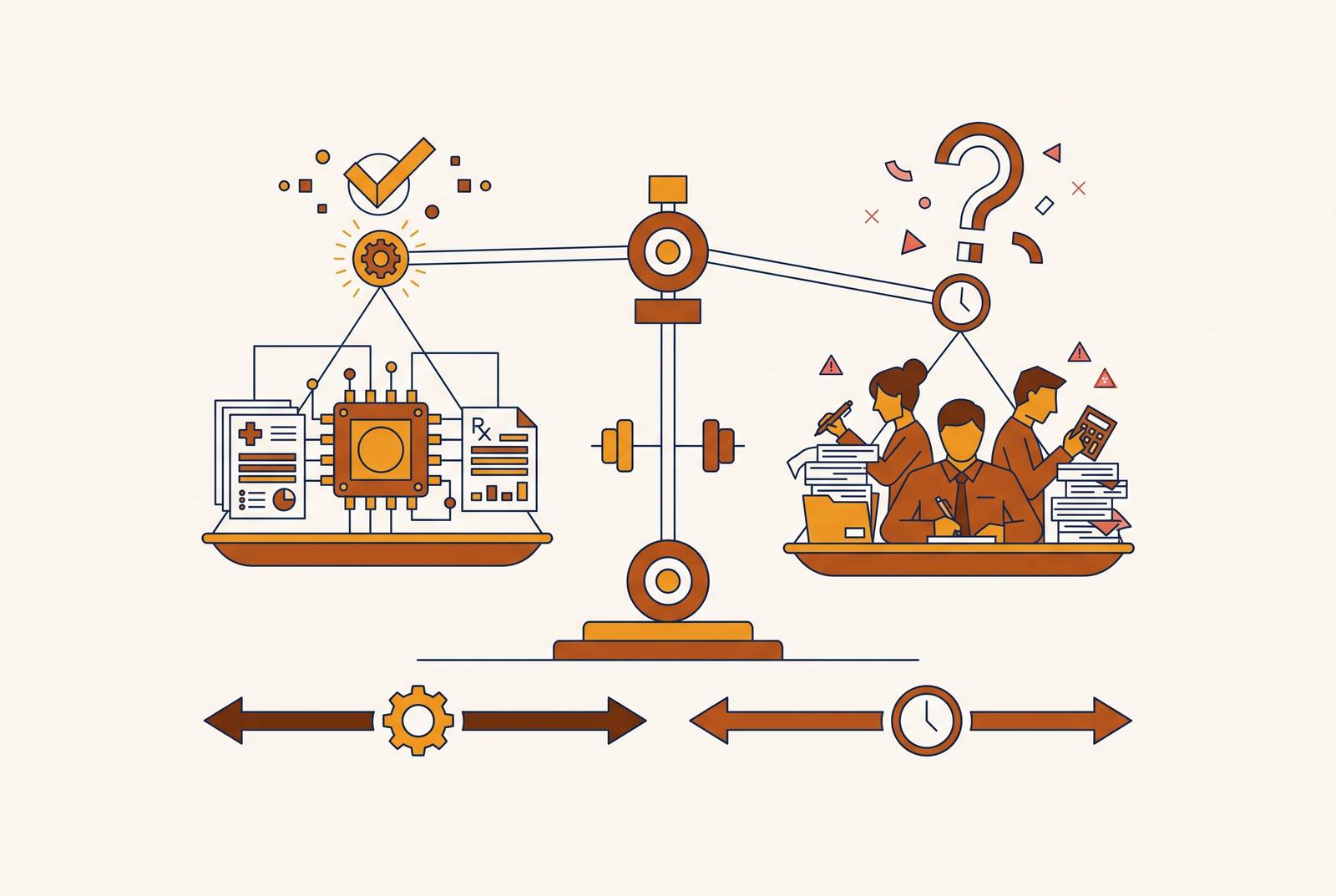
AI wins on speed and consistency, but human billers still catch what algorithms miss.
Denial rates hit 11.8% in 2024, up from 10.2% just a few years prior, according to Experian Health's State of Claims Report 2025. That climb is a sustained trend. It's a structural shift in how payers adjudicate claims, and it's forcing a reckoning over who, or what, should be catching errors before they turn into revenue loss.
Kodiak Solutions puts the cost of that shift at $48.4 billion in net revenue leakage from denials in 2025, up 25% from $38.6 billion the year before. Up to 65% of denied claims never get reworked at all; they're written off, not fought. Yet Premier Inc. reports that 70% of appeals that do get filed are overturned. Read those two numbers together and the diagnosis writes itself: practices are losing this war on the merits. It's a war most practices aren't showing up to fight, because the speed and pattern recognition needed to fight it systematically has been out of reach for staff working claims by hand.
That's where the comparison between two kinds of approaches actually starts to matter, and where it stops being a marketing pitch and becomes an operational one.
What "accuracy" actually means at each stage of the revenue cycle
Accuracy isn't a single number a practice can point to and call it done. A clinic can run near-perfect eligibility verification at check-in and still hemorrhage revenue three steps later because a coder missed a modifier or a claim got scrubbed against the wrong payer's rule set.
The revenue cycle breaks into five distinct accuracy challenges, and each one has its own failure modes: eligibility and coverage verification before the visit, claim scrubbing and pre-submission error detection, coding accuracy on complex or specialty-specific encounters, denial pattern recognition across payer populations, and appeals, meaning argument construction and payer-specific judgment.
Industry benchmarks for high-performing operations typically target a clean claim rate in the high 90s. Most independent and group practices sit well below that mark, and the gap between where they are and where top performers land translates directly into delayed cash and write-offs that didn't need to happen. AI and human staff don't compete head-to-head across this whole cycle. They win at different stages, for different reasons, and mapping those stages precisely is the only way to build a billing operation that doesn't leak money at the seams.
Where AI has a measurable accuracy advantage over in-house staff
Consistency is the first advantage, and it's the least glamorous one. AI applies the same validation rules to every claim, regardless of volume, time of day, or who's on shift. Human review varies with experience, fatigue, and turnover, none of which show up on a workflow diagram but all of which show up in the denial rate.
Eligibility verification is where the gains get concrete. Practices that implemented AI-assisted eligibility verification have reported material reductions in denial rates, with eligibility-related gains consistently ranking among the largest single pre-submission improvements documented in current research.
Pattern detection is the second real edge. AI can surface denial patterns across hundreds of payers at once, a scale no in-house team of typical size can replicate by hand. Predictive models score claims for denial risk before they're ever submitted, routing the risky ones to a human reviewer instead of letting them fail and boomerang back weeks later. That matters more now than it used to, because payers are running the same playbook in reverse: requests for information that trigger denials rose 9% from 2022 to 2024, and some algorithmic insurer denial systems are alleged to drive automatic denials on a large share of decisions. A practice without AI-assisted pattern recognition is operating at a structural disadvantage. It's fighting an automated opponent with manual tools.
Speed compounds all of this. AI processes claims in real time, while manual review creates queues that push claims past filing windows. Speed is inseparable from the accuracy conversation. It is an accuracy mechanism, because a claim filed late is a claim denied regardless of how clean it was.
Claim scrubbing follows the same logic. AI-driven scrubbing catches missing fields, formatting mismatches, and payer-specific anomalies that a biller working a high-volume queue is going to miss, not out of carelessness but because no person reviews a thousand claims with the same attention on claim 900 as on claim 10.
On coding specifically, the picture is more textured. Top AI coding tools report autonomous accuracy well above 90% for routine encounters, climbing into the high 90s for narrow specialties like radiology. That's a real number, but it's not a universal one, and it starts to break down exactly where complexity enters the picture.
Where human billers still outperform AI, and why the gap is real
Complexity is where the algorithm runs out of road. Payer-specific behavioral judgment, knowing how a specific payer actually behaves in practice, which arguments land, which documentation triggers a second-level review, which adjuster has which pattern, is institutional memory. No algorithm currently on the market fully replicates it.
Consider what happened when UHC tightened its authorization-to-claim matching logic in 2025 as part of an AI adjudication upgrade. NPI mismatches, date-of-service range mismatches, and place-of-service mismatches now trigger automatic denial under the updated adjudication logic. A biller who knows that change catches the mismatch before the claim goes out. An AI tool trained on pre-2025 denial patterns has no reason to flag it, because in its training data, that combination never used to be a problem.
Carelon Medical Benefits Management, which manages BCBS specialty prior authorization programs across multiple states, updated its clinical criteria for interventional pain management in the third quarter of 2025, effective July 26, with spine surgery guidelines also revised in 2025. Practices that were routinely getting authorization for these procedures in 2024 started seeing denials in 2025, with no change whatsoever in their own clinical approach. A biller who reads payer policy communications catches that shift before it costs anything. An AI model trained on historical approvals doesn't see it coming until enough denials pile up to move the model, and by then the damage is already booked.
Complex and specialty-specific coding tells a similar story. Accuracy that looks strong in radiology drops materially in something like behavioral health, to the point that a single coding tool is really behaving like two different products depending on the specialty it's applied to. Hybrid setups, AI paired with human review, consistently produce the highest accuracy of any model tested, which says something important: the ceiling comes from combining AI and humans together. It's the combination.
Appeals are where human judgment is least replaceable. Winning a denied claim back takes strategic argument construction, real communication with a payer's review staff, and an understanding of the clinical context behind the documentation, none of which reduce cleanly to pattern matching. Available research consistently finds that practices combining staff oversight with AI outperform those running automation alone without human monitoring. Oversight, not automation by itself, is the differentiator. Well-prepared first-level appeals overturn 40 to 60% of denials industry-wide, and top-performing operations drive overturn rates to that level, but the preparation behind those numbers is human work, start to finish.
There's also a risk on the automation side that doesn't get discussed enough. There is a documented risk on the automation side that doesn't get discussed enough: unsupervised AI tools can introduce new errors rather than simply failing to catch existing ones, and those introduced errors are often harder to trace than the manual mistakes they replaced.
None of this is an argument that in-house staff are doing fine as-is. Research consistently shows that many in-house billers don't review Explanations of Benefits routinely, and a large share have never appealed a single denied claim in their career. That's a case for keeping them in the loop rather than automating them out. It's evidence of a capacity problem, a workflow problem, and it points toward a different operational model rather than a wholesale swap.
How payer behavior in 2025 and 2026 is reshaping what accuracy requires
Denial rates are not remotely uniform across payer types, and treating them as one number obscures where the real risk sits. Commercial payers run denial rates between 10 and 16% depending on the payer. Traditional Medicare fee-for-service runs a comparatively tame 4 to 6%. Medicare Advantage plans now exceed 17%, according to Experian, more than double the traditional Medicare rate and up 4.8% year over year, the steepest increase of any payer category tracked.
The dollar stakes are rising in step. MDaudit found the average denied amount tied to a Medicare Advantage claim rose 22.4% to roughly $1,000 between 2024 and 2025. Each individual denial now carries more weight than it used to, which means the cost of missing one has gone up too.
Payers are deploying their own AI to generate denials faster than manual billing staff can respond to them, and some algorithmic denial systems are alleged to drive automatic denials on a large share of decisions. This is a present risk practices need to plan around. It's the environment they're already operating in.
Prior authorization remains the single biggest bottleneck in the system. Physicians and staff spent an estimated 14.5 hours a week on prior authorizations in 2024, per the AMA, nearly half a clinical workday, every single week, spent on paperwork instead of patients. The AMA's 2024 survey found that 29% of physicians believed prior authorization had contributed to a serious adverse event for a patient. And yet a substantial majority of Medicare Advantage prior authorization appeals in 2024 were partially or fully overturned, meaning care that was ordered and ultimately judged necessary got delayed anyway, simply because the appeal took time to file.
At least 31 states passed laws in 2025 limiting how insurers use prior authorization, a regulatory response that's creating new compliance requirements and new timelines, which in turn means AI tools trained on last year's rules need updating just to stay accurate. Accuracy in 2026 now extends well beyond submitting clean claims. It's about keeping pace with payers who are actively rewriting their own rules and using automation to adjudicate faster than most practices can respond by hand.
Why the ROI gap between AI adoption and realized returns is mostly a deployment problem
Here's the spread that should give every revenue cycle leader pause: 63% of healthcare organizations are already using AI for revenue cycle work, and 51% of health system leaders list AI as a priority focus, according to McKinsey's 2025 RCM buyer survey. Yet only around 15% of organizations using revenue cycle AI report positive ROI, per data from HFMA and FinThrive.
That's a massive gap between adoption and return, and it isn't evidence that the technology underperforms. Roughly half of organizations cite IT infrastructure limits as a barrier to realizing value, and a large share point to integration challenges, with the AI sitting on top of systems it was never built to talk to. Many simply cannot demonstrate returns at all, not because the tool failed, but because it was never deployed against the part of the cycle that actually bleeds money.
A significant share of AI investment has been directed toward ambient clinical documentation and coding assistance, automating the paperwork generation side of the business, while comparatively less is aimed at denial management specifically. Practices have automated the parts of the cycle that generate volume. They haven't automated the parts that prevent the loss.
The cost of leaving that gap unaddressed keeps climbing. The average cost per denied claim rose from $43.84 in 2022 to $57.23 in 2023, and the average denial tied to a request for information has been reported at around $450 per claim in 2025. For a practice running a typical monthly claim volume against an 11.8% denial rate, that's not a rounding error on the books.
Staffing makes the problem worse, not better. Health information departments broadly report staffing pressures over recent years, which means the in-house model is being squeezed from both directions at once: claim volume rising, staff capacity shrinking. What actually moves the needle isn't the software alone. A biller working alongside AI can now handle a workload that previously required several people, and the accuracy gain reflects the human and the tool working together. It's what a skilled person can do once the repetitive part of the job stops eating their whole day.
What the most accurate billing operations actually look like in practice
The hybrid model represents the strongest option available, chosen on its own merits. It's the highest-accuracy configuration available, full stop, beating both human-only and AI-only approaches on coding accuracy in every comparison the research offers.
In the best-performing operations, AI handles continuous eligibility verification before every visit, pre-submission claim scrubbing against payer-specific rules, denial pattern detection and risk-scoring across the entire claim population, automatic routing of low-confidence or high-risk claims to a human reviewer, straightforward remittance posting and payment reconciliation, and first-draft appeal letters that a person then refines.
Humans, meanwhile, handle the exception work AI flags as uncertain, the appeals that need strategic argument and clinical context and a real understanding of how a specific payer adjudicates, the ongoing job of reading payer policy bulletins and translating new requirements into workflow changes before the denials pile up, and contract-level disputes or underpayment patterns that only show up when someone reasons across time, not just across a single claim.
There's a compounding advantage buried in that division of labor that's easy to overlook. When an experienced biller leaves a practice, their knowledge of how each payer behaves walks out the door with them. A billing operation that captures that knowledge in its AI systems and its documented workflows keeps it. That's not a one-time efficiency win. It accumulates, the way institutional memory always does when someone finally bothers to write it down.
None of this requires tearing anything up to start. The strongest operations layer AI onto the EMR and clearinghouse workflows already in place, rather than demanding practices rebuild the front desk from scratch to see the benefit.
For any practice evaluating a billing partner or a new tool, AAPC's 2025 finding, that staff-AI collaboration beat automation alone by a mean of 18% in denial rate reduction, is the number to hold onto. It reframes the whole evaluation. The question worth asking isn't whether a vendor uses AI. Everyone will say yes. Human judgment enters that workflow at a specific point, and something happens the moment the AI isn't sure.
Sources
- AI in Medical Billing: Hype vs. Real Gains in 2025
- AI + Human Hybrid Medical Coding: Why Q3 2025 Is Your Moment
- AI Revenue Cycle Management Automation Statistics 2026: Denial Rates, Cost Savings, and ROI Data
- Payer Policy Changes and Prior Authorization in 2025 | No More Auth Delays Act
- kff.org
- medicaleconomics.com
- statmedical.net