Working Denials in Real Time vs End-of-Month Queues
Delays in processing denials cost more money than the denials themselves.
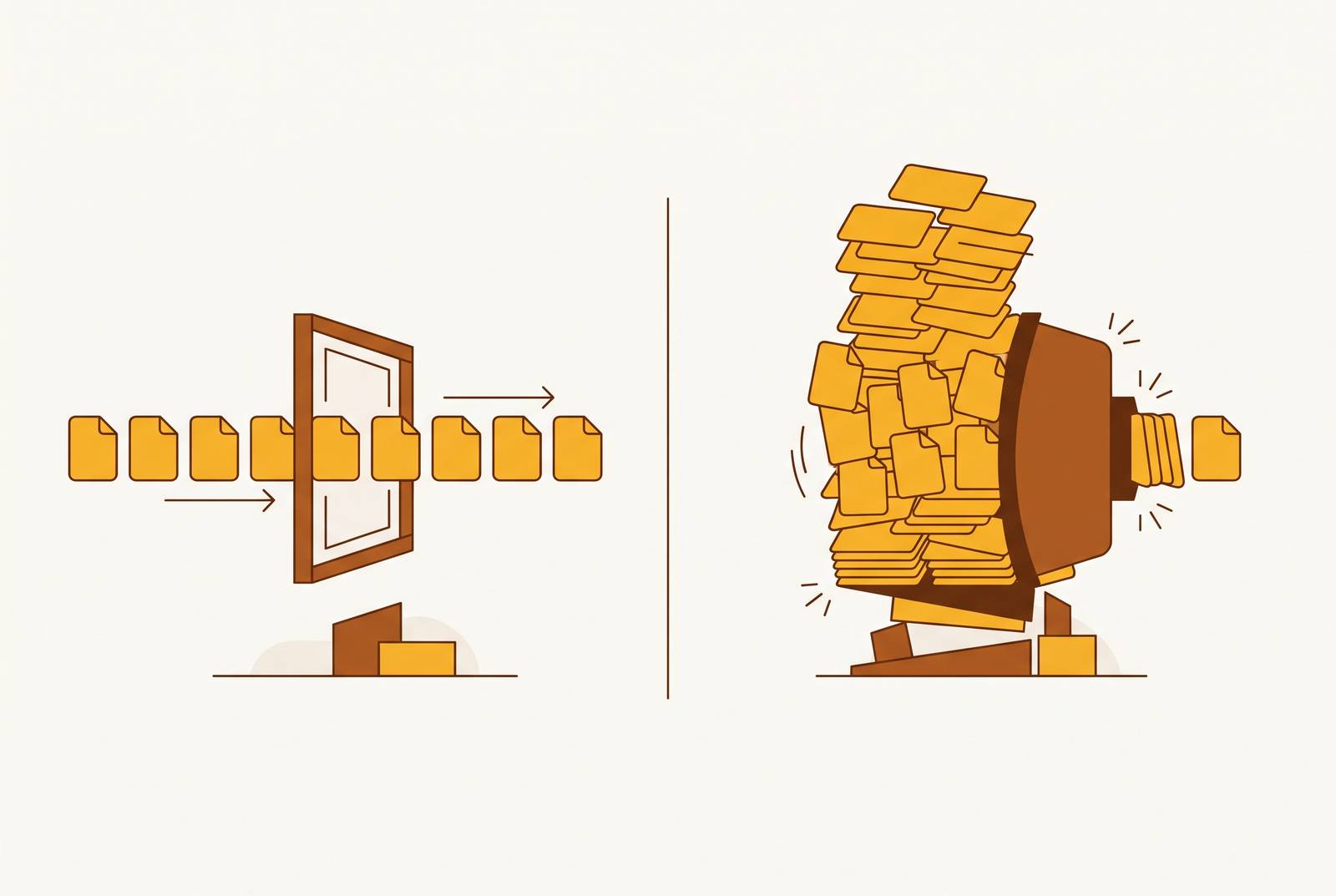
Denial management has a timing problem that the industry keeps misdiagnosing as a staffing problem. Practices respond to rising denials by hiring more billers or tightening front-end documentation, treating the whole thing as a volume issue to be absorbed with more labor. Denials have grown more complex while most practices still work them the way they did a decade ago: in batches, reviewed once a month instead of as they arrive. The denial itself rarely kills the revenue. What kills it is everything that happens, or fails to happen, while the claim sits waiting for someone to open the file.
How denials age out of collectibility while they sit in a queue
Timely filing windows, appeal deadlines, and payer memory all run on clock time. They do not pause for a practice's billing calendar, and they do not care whether a claim sits in position four or position four hundred of a work queue. A claim addressed quickly still carries a reasonable chance of full collection; once it ages well past the 90-day mark, that probability falls off sharply, as reflected in the industry's deteriorating AR-over-90 figures. The path from recoverable to written-off is a slope, not a cliff, and the month-end queue is what pushes practices down it.
AR aged past 90 days now sits above 35% industry-wide, according to TechTarget / Kodiak, a threshold that reflects a significant deterioration from prior benchmarks for healthy receivables management. That gap is not random variance. It reflects aging built into the structure of how claims move through a monthly review cycle instead of a continuous one.
Aging also makes the work itself more expensive. Reworking a single denied claim costs somewhere between $25 and $118 in administrative labor, and as denials sit longer and stack up in higher volumes, the marginal cost of recovering each dollar climbs right alongside them. Most of that labor never even gets spent, since MGMA estimates that 50 to 65% of denied claims are never reworked at all. For most of what lands in the queue, the queue is where the claim goes to die.
Three deadlines drive this, and none of them bend. Timely filing limits vary by payer but typically run 90 to 365 days from the date of service; miss that window and the claim is dead regardless of clinical merit. Appeal deadlines, measured from the date of denial rather than the date of service, often run just 30 to 180 days, non-negotiable on either end. Payer memory is the quieter third leg: a corrected claim depends on the payer matching it back to the original claim data, and that match gets shakier the longer a claim sits unaddressed.
The difference between working a denial on day one versus day 45 is not subtle. On day one, the claim record is fresh, the denial reason code points to something specific, and the adjudication logic the payer used is still legible to whoever's reading it. None of that gets better with age. All of it degrades, and degradation is the whole story here.
What payers are actually denying in 2024–2025, and why the mix makes delays more damaging than before
The composition of denials has shifted in a way that makes speed matter more than it used to. Prior authorization denials, the category practices have spent the most effort trying to prevent on the front end, fell 7.7% in 2024. Medical necessity denials rose 5%, and requests for information rose 5.4%. That reshuffling matters because prior auth denials are largely preventable before the claim ever ships. Medical necessity and RFI denials require documentation responses, and those responses live inside short appeal windows that only get weaker the longer they wait.
RFI-triggered denials climbed as payers lean on AI systems to flag claims for additional information. These are substantive clinical or administrative challenges that demand a careful, timely response. Treating them like routine paperwork is exactly how they get missed.
Missing or inaccurate claim data now causes half of all denials, according to Experian Health's 2025 State of Claims survey, with prior authorization issues, incomplete patient registration data, and coding inaccuracies close behind. At the transaction code level, CO 16 (missing or invalid information) and CO 50 (medical necessity) are among the most common denial codes in circulation, and both require specific corrections that get harder to reconstruct the longer the underlying records sit untouched.
Payer type matters too, and Medicare Advantage is the outlier worth naming directly. MA plans posted a materially higher initial denial rate than commercial plans, according to Premier, and MA final denial rates ran more than double the rate seen in traditional Medicare. UnitedHealthcare has faced scrutiny over algorithmic denial practices, and that's the detail that should worry practices most: when denials get generated at scale by an algorithm, they arrive on the payer's schedule, not the practice's. A response built around monthly review cannot keep pace with a machine that doesn't take a month off. That asymmetry, algorithmic issuance against manual, calendar-bound review, is the actual crisis here, more than any single denial category.
How month-end queuing actually works in practice and where the workflow breaks down
The standard model is familiar to anyone who has worked a billing department. Denials pile up in a work queue throughout the month; staff triage them in bulk once the billing cycle closes, sort by dollar amount or by payer, and quietly deprioritize the small or complicated ones. That approach made sense once, back when claim volumes were lower and payer rules changed slowly enough for manual review to keep pace.
That slack is gone. Payer rule changes arrive with no warning, and a denial spike caused by a new claims edit stays invisible inside a month-end queue until dozens of claims have already aged past the point of easy recovery.
Bulk triage introduces its own errors, and this is the part practices consistently underestimate. A staff member sorting by dollar amount can spend twenty minutes on a $150 denial while missing the filing deadline on a $4,000 claim sitting two rows down that looks, at a glance, nearly identical. Low-dollar denials get skipped almost by design. At scale, those skipped claims represent real collected revenue that never gets collected, and nobody notices, because no single miss looks like a crisis on its own.
The cost stays invisible for a structural reason: a write-off shows up in the books as an accounting entry, not as a failed appeal or a missed deadline, so there's no feedback loop telling anyone what actually went wrong. Staff turnover compounds it. The knowledge of which edit code a payer uses for a specific policy change, or what documentation that payer will actually accept on appeal, lives in someone's head. The month-end queue model depends on that memory and has no structural way to hold onto it once the person walks out the door.
What working a denial in real time actually requires operationally
Real-time denial work runs on a different trigger than batch processing does. The response starts when the denial event happens, not when the calendar says it's time to review the queue. That distinction is the whole argument, and everything else in this section follows from it.
A few specific components have to work together to make that trigger real. Denial feeds have to surface to billing staff the moment a denial is received, not after a nightly batch job or a manual download of the electronic remittance advice. Categorization by reason code and root cause needs to happen automatically, at the moment of receipt, so the correct response, whether that's a corrected claim, a formal appeal, a peer-to-peer request, or a documentation pull, gets identified without a human sitting in the loop as a bottleneck. Prioritization needs to run on recovery probability and deadline proximity rather than dollar amount alone: a $300 claim five days from its timely filing deadline outranks a $1,200 claim that still has 60 days on the clock, full stop. Response routing has to be payer-specific, too, because knowing that one payer accepts a reconsideration request with no formal appeal while another requires a specific form within 30 days is knowledge that has to live in the workflow itself, not in one employee's head.
AI has a specific and limited job here, and the limits matter as much as the job. It's suited to recognizing patterns across claim histories faster than manual review can, to scoring claims for denial risk before submission so intervention happens upstream of the problem, and to monitoring eligibility continuously so a coverage lapse or benefit change gets caught before the claim goes out the door rather than after it comes back denied.
Its limits matter just as much as its strengths. Medical necessity appeals, peer-to-peer negotiations, and disputes that require a payer-specific documentation strategy all depend on billers who know how a given payer actually behaves and can build a response that succeeds. Practices betting entirely on automation to solve this are making the same mistake as the ones stuck in month-end queues, just with better software underneath it. The real-time model works as a combination: AI absorbs the volume, the speed, and the pattern detection; trained billers handle the exceptions that require a human judgment call. Neither piece alone gets a practice to real-time response, and pretending otherwise is how automation projects quietly underdeliver.
What the metrics look like when practices move from queue-based to real-time denial work
Clean claim rate is the number to watch first, because it's a leading indicator rather than a lagging one. Industry benchmarks place a strong first-pass acceptance rate in the high 90s, with top-performing organizations pulling ahead of peers through tighter pre-submission scrubbing. Moving from a weak first-pass rate to a stronger one translates into faster cash flow, and that kind of shift tends to show up in days-in-AR figures within months, not years.
Denial rate benchmarks tell the same story from a different angle. Industry benchmarks suggest that top-quartile practices keep denial rates meaningfully lower than peers, with the broader industry average running considerably higher. Practices still relying on month-end queues, still missing appeal windows on claims that have aged past their deadlines, land on the high end of that range. There's no version of the queue model that produces a top-quartile denial rate; the mechanics work against it structurally, not incidentally.
Days in AR is the lagging confirmation. An industry sitting above 35% on the AR-over-90 measure reflects years of queue-based denial work compounding. That points to a bad decade of process, not a bad quarter.
Appeals data shows how much money never even gets a chance at recovery. Fewer than 1% of denied claims are ever appealed, despite internal appeals succeeding 44% of the time, and 54.3% of payer denials that were actually appealed ended up overturned. Net collection rate rounds out the picture, and practices that consistently fail to work denials in time watch their NCR drift downward. The collection rate on commercially insured patient balances fell from 37.6% in 2023 to 34.4% in 2024, a decline tied closely to how quickly a practice acts on the denials it receives rather than to payer mix or benefit design. Timing is one of the few levers a practice still fully controls.
How to assess whether a practice's current denial workflow can support real-time response
A handful of concrete questions separate a practice that can move to real-time work from one still structurally tied to the month-end model. How long does it take from a denial landing in the ERA to a staff member actually seeing it and acting on it: hours, days, or weeks? Is reason code categorization happening automatically, or is a person doing it by hand, and when in the cycle does that happen? Are claims getting prioritized by deadline proximity or by dollar size, and what's the actual policy on low-dollar denials? What does the current first-pass rate, denial rate, and AR-over-90 percentage look like, and how recently did anyone check? When a billing staffer leaves, what happens to the payer-specific knowledge that walked out the door with them?
A few warning signs show up consistently in practices running a queue-based model that's leaking revenue. Write-off volume climbing without a matching rise in charity care or contractual adjustments is one. Timely filing denials showing up with any regularity is another; CO 29 appearing in the denial mix is about as direct a signal as exists that claims are aging past their window before anyone gets to them. Month-end AR reviews that keep surfacing the same "old" denials with no action taken belong on the list too, alongside a denial rate sitting above 5% with no clear explanation for the excess.
Underneath all of these diagnostics sits one structural question: is the billing operation built to receive and respond to payer decisions as they arrive, or is it built to periodically review a stack of them after the fact? Most practices, audited honestly against the list above, land on the second answer, and that answer determines whether real-time response is achievable with current staffing and tools or whether the workflow needs rebuilding from the ground up.
Practices that can't build this internally, and most can't do it alone given the staffing and technology it requires, need to be specific about what they look for in a billing partner. Real-time denial feeds with automated reason-code routing matter more than a vendor's list of features, since a nightly batch cycle just reproduces the same broken model on someone else's server. AI-driven claim scrubbing that catches errors before submission should shrink the volume of denials the back end has to manage in the first place, not just process them faster once they arrive. Expert billers who handle exceptions and appeals need payer-specific knowledge that builds over time, not staff who rotate through and take that knowledge with them when they leave. Integration with existing EMR and clearinghouse systems has to work without forcing front-desk staff into new workflows, and reporting on clean claim rate, denial rate, and AR aging has to run in real time, arriving well before the deadlines it should have flagged have already closed.