AI Medical Billing Companies That Eliminate the In-House Billing Team Entirely

AI medical billing companies that promise to eliminate the in-house billing team entirely do so by absorbing every operational function of the revenue cycle, from eligibility verification through payment posting, not by automating a handful of repetitive tasks and calling it done. The companies that actually deliver on that promise pair AI automation with in-house billing specialists who handle the exceptions automation surfaces but cannot resolve. If you skip the billing expertise, recoverable revenue still sits on the table. This article lays out what full replacement actually requires operationally, where pure automation falls short, and which companies in the market in 2026 come closest to the standard.
Why practices are replacing their in-house billing teams
The appeal window on a denied prior authorization does not wait for a practice to staff up. When a claim gets denied, the clock to appeal starts immediately, and a billing office that is short-staffed, mid-hire, or simply outpaced by the volume of denials coming back cannot always turn around a strategic appeal before that window closes. That single pressure point, a shrinking labor pool for billing roles paired with a payer side that has already automated its own denial and adjudication logic, creates a mismatch in speed and memory between a manually staffed billing office and a payer system that increasingly runs its reviews through automated adjudication at a pace no human team can match claim by claim.
The labor shortage behind this is structural rather than cyclical, and that distinction matters for how practices should respond to it. A practice cannot hire its way out of a workforce gap that reflects fewer people entering medical billing roles industry-wide, which means the realistic path for most practices is not recruiting harder but outsourcing to an organization that already has trained staff, established systems, and payer-specific knowledge built up over time. Capital markets have already priced this shift as permanent. As of August 2026, more than $500 million had been invested in AI-powered revenue cycle management platforms in 2026 alone, a figure that includes a $120 million Series D for Candid Health closed on July 22, 2026, a $70 million raise for Commure in May 2026, a $40 million Series C for Adonis in March 2026, and $17 million for Anomaly Insights. That volume of investment, concentrated in a single calendar year, reflects a market judgment that outsourced AI billing is a durable, high-value category rather than a niche experiment, and it signals to practices watching from the outside that the shift away from fully in-house billing operations is not a trend to wait out.
What "eliminating the in-house billing team" means operationally
Before any vendor's claim to replace a billing team can be evaluated, the claim itself needs a concrete definition. Full replacement means absorbing every revenue cycle function the in-house team was performing. A genuine full-service operation takes over pre-visit eligibility verification, running continuous real-time checks rather than batch pings, and it resolves plan-specific edge cases and coordination of benefits questions that rules-based automation alone cannot work through. It takes over prior authorization in full: identifying when an authorization is required before the service happens, submitting the request with clinical evidence extracted through natural language processing, tracking the status of that request, and managing the peer-to-peer review when the payer denies it, rather than simply routing the paperwork and stepping back. It takes over claim scrubbing: it catches anomalies and validates against payer-specific rules before a claim ever goes out, and a human reviews high-dollar or unusual claims before submission. It takes over denial management, categorizing and prioritizing denials by how likely they are to be recovered, drafting the appeals, and escalating contract-level disputes to specialists, working each denial as it arrives. It takes over payment posting: it auto-posts straightforward explanations of benefits while reconciling partial payments and flagging underpayments for follow-up. It takes over patient billing and the often-delicate conversations around balances and payment plans. And it takes over payer intelligence, tracking when a payer quietly changes a rule and updating workflows before that change produces a wave of denials.
What elimination does not mean is a disruption to how the practice itself runs. A genuine full-service billing company integrates with the practice's existing EMR and clearinghouse, so the front desk, the scheduling workflow, and the clinical documentation process stay exactly as they were. Clinical documentation, charge capture decisions, and anything that requires a licensed clinician's judgment remain inside the practice regardless of who handles billing, because a billing company works from what the practice generates. That distinction, between a vendor that touches every billing function and one that automates a convenient slice of it, is the standard against which every claim of "full replacement" in this market should be measured.
Pure AI automation without billing specialists leaves revenue on the table
Automation is genuinely good at certain parts of this cycle. High-volume eligibility checks, routing of standardized claims, auto-posting of straightforward EOBs, trend analysis across denial patterns, and drafting initial appeal letters from template logic are all tasks where AI performs at a speed and consistency no human team could replicate claim by claim. None of that is in dispute, and no practice evaluating this market should dismiss what automation does well. The trouble starts at the functions where most recoverable revenue actually sits: complex denials, payer-specific appeals, prior authorization peer-to-peer calls, and underpayment identification. Each of these requires judgment that current AI systems cannot supply on their own.
Acuity Health Solutions' 2026 assessment of the market called fully autonomous billing the single biggest overstatement circulating in the industry right now, because the real-world process involves judgment calls, payer-specific interpretation, appeal strategy, and constant exception handling that AI cannot yet manage without a person in the loop. Surgical and specialty-specific coding support still needs human expertise, because someone has to defend modifier usage and bundling logic under audit. Strategic denial appeals and contract-level disputes still need a person who can construct an argument rather than just draft a letter, and who can judge when a peer-to-peer call will outperform a written appeal. You still need someone who knows how a specific payer actually behaves against its own contracted rates, not just what the contract says on paper, to identify underpayments. Catching a payer's quiet policy change before it produces a wave of denials requires a team monitoring that payer continuously, since a model trained on historical patterns cannot detect a shift that has just happened underneath it.
If you treat these functions as automatable without human oversight, the cost compounds quickly. When AI mishandles an exception and no specialist catches it in time, the claim ages past its appeal window, and that revenue is lost permanently. Roughly two-thirds of denied claims that are not actively worked are never resubmitted. The scale of what is recoverable, if someone bothers to contest it, is laid out in KFF's analysis of 2025 insurer data: when denied prior authorization requests were appealed, insurers overturned 67% of Medicare Advantage denials, 47% of Medicaid managed care denials, and 43% of ACA Marketplace denials. Most denials, in other words, are wrong on the merits, and the money attached to them is recoverable if someone with the right expertise contests it. A billing system that cannot escalate a denial to a human who knows how to fight it is a permanent revenue leak dressed up as automation.
The revenue cycle metrics that separate a functioning full-service billing operation from a partial one
Every claim about replacing an in-house billing team should be testable against numbers, not accepted on the strength of a pitch deck. A clean claim rate of 95% or higher is the first marker of a functioning operation; anything below 90% means front-end scrubbing is failing and denials are being generated upstream that never needed to happen. A denial rate under 5% marks a high-performing operation, but a rate between 10% and 15% is average or below-average, and the broader industry average across all practice types runs roughly 11% to 13%. Net days in accounts receivable should be 35 days or fewer for an operation that is actually working its claims; once that figure climbs past 50 days, claims are sitting unworked. Net collection rate, the measure of what percentage of collectible revenue actually gets collected across the full cycle from submission to payment, should run at 95% or higher, and this single number is the clearest test of whether the entire cycle is being managed end to end.
The gap between a manually staffed shop and an AI-native operation with specialist oversight is not a marginal difference in performance. Industry assessments in 2026 consistently found that practices running unoptimized billing workflows lose a meaningful share of their annual revenue to preventable inefficiencies, because no one on staff was working that money. Payer mix complicates any attempt to apply a single benchmark across every practice. KFF's analysis of 2025 insurer data found that Medicare Advantage insurers denied roughly 12% of standard prior authorization requests, Medicaid managed care insurers denied roughly 14%, and ACA Marketplace insurers denied roughly 18%, with individual payer rates ranging from the single digits to above 20% depending on the specific plan. A practice weighted heavily toward Marketplace patients will face a different denial environment than one weighted toward Medicare Advantage, which means the right billing partner tracks the practice's own specific payers.
The hybrid model inside a full-service AI billing company
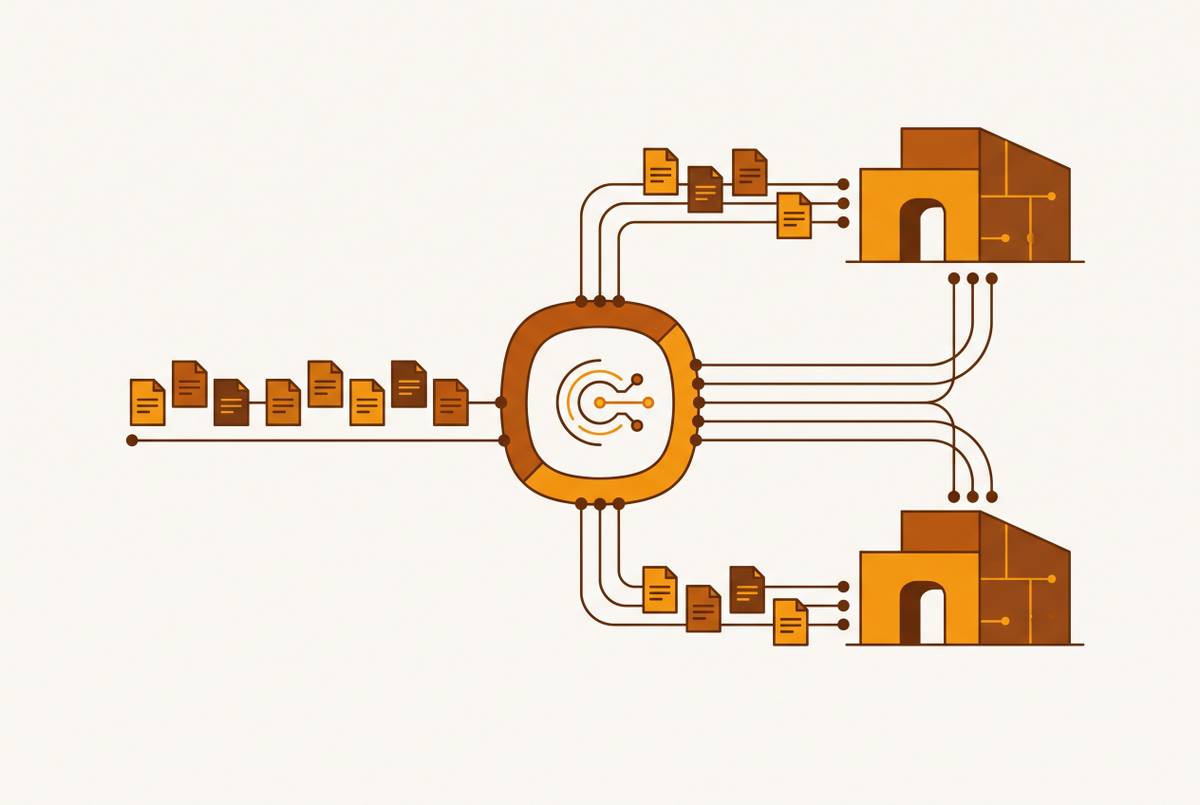
Inside an operation built to actually deliver full replacement, AI and human specialists divide the work along a clear line; they do not overlap or compete for the same tasks. The AI layer runs continuous eligibility verification, scrubs claims against current payer-specific adjudication rules, routes submissions, categorizes and triages denials by how likely they are to be recovered, auto-posts clean EOBs, and drafts initial appeal letters by matching denial reason codes to template logic. The specialist layer picks up everything the AI flags but cannot resolve on its own: plan-specific coordination of benefits questions, modifier ambiguity, documentation gaps, strategic appeal arguments on high-value or complex denials, peer-to-peer review calls, underpayment identification against contracted rates, and updating payer behavior profiles the moment a payer changes its adjudication logic.
The design of the handoff between those two layers determines whether the model works in practice. An AI system that flags an exception without enough context forces the specialist to start an investigation from scratch, which defeats much of the speed advantage automation was supposed to provide. A well-built handoff surfaces the denial reason, the claim's history, the payer's known behavior pattern, and how much time remains in the appeal window, so the specialist can act immediately. The institutional memory this model builds over time is itself a compounding asset: every payer behavior a specialist documents, every fix that works, every policy change caught early becomes part of the system's working knowledge. In a traditional in-house team, that knowledge walks out the door when a staff member leaves. In the hybrid outsourced model, it stays with the operation and keeps compounding.
Operational assessments of AI billing through 2026 converge on the same finding: most billing operations are not replacing the entire process with AI, but layering specific tools onto specific workflows while keeping experienced people in charge of the judgment-heavy work. The practices getting the best results are the ones where that division of labor was designed deliberately. For the physician or practice manager, the result of a well-built hybrid system is straightforward to observe day to day: claims move through the cycle without requiring internal staff to intervene, exceptions get surfaced and resolved by the billing company's specialists before anyone on the clinical side is even aware of them, denials get worked the moment they land instead of sitting in a queue, and the practice's EMR and clearinghouse workflows stay exactly as they were before the transition.
AI medical billing companies that offer full-service replacement for the in-house billing team
Measured against the standard laid out above, full cycle coverage, an AI-plus-specialist structure, and measurable outcomes rather than marketing claims, the companies operating in this space in 2026 land in noticeably different places.
Altair Health is built for independent and small-to-mid-size physician practices that want to eliminate in-house billing operations without replacing their EMR or retraining their front desk. The service integrates directly with existing EMRs and clearinghouses, so the practice keeps its workflow intact while gaining a billing operation that covers the full revenue cycle, from pre-visit eligibility verification and prior authorization through claim scrubbing, submission, denial management, appeals, patient billing, and real-time payment posting. Its structure pairs AI automation with in-house expert billers who work the exceptions the AI surfaces, so machine-speed pattern recognition combines with institutional knowledge of how specific payers actually behave, which is what pure automation alone cannot replicate. When a payer changes its adjudication logic without notice, Altair's specialists are positioned to detect the change and update workflows before it produces a spike in denials, building the kind of institutional memory a practice struggles to maintain internally given typical staff turnover. Altair does not perform medical coding and does not conflate coding with billing; if a practice needs coding support, it should address that as a separate need, because what Altair runs is the billing operation itself.
Candid Health is an autonomous revenue cycle management platform founded by former Palantir data infrastructure specialists, and as of its July 2026 Series D announcement it processes roughly $7 billion in annual claim volume across more than 200 healthcare provider organizations. It raised $120 million in that Series D round on July 22, 2026, led by Sixth Street Growth, tripling the valuation it had set during its February 2025 Series C. The scale of that capital raise points toward an orientation suited to mid-to-large provider organizations, which means independent and small practices evaluating Candid Health should weigh whether the platform's scale orientation matches the kind of support a smaller operation needs.
Commure raised $70 million in May 2026 to scale its RCM automation capabilities, and it leans toward health systems and larger group practices. If you are considering Commure, check its integration requirements against your existing EMR environment before you assume a smooth fit.
Adonis functions as an AI orchestration layer for revenue cycle workflows and raised $40 million in its Series C round in March 2026. It operates as an intelligence and workflow layer rather than a full-service managed billing operation, so a practice evaluating Adonis needs to determine whether it wants a tool that augments a billing team it already has or a service meant to replace that team.
athenahealth bundles an EHR, billing, and AI tools into a single platform aimed at small and mid-size practices, and a May 2026 platform comparison listed it as a strong option for practices that want their EHR and billing handled inside one system. That bundling is also its defining limitation for some practices: adopting athenahealth's billing tools means adopting its EHR as well, so a practice with an established EMR it intends to keep should weigh whether the bundled approach fits its situation or introduces switching costs it would rather avoid.
CodaMetrix's scope is medical coding, not billing, and it sits on top of an existing EHR to address the coding workflow. If a practice needs its billing operations managed end to end, it should evaluate CodaMetrix as a coding-layer tool rather than mistake it for a billing company, because coding and billing are genuinely separate disciplines even though vendors sometimes blur the line between them.
Evaluating whether a full-service billing company has replaced your team's workload
The gap between a billing company that has absorbed a practice's full workload and one that has automated a subset of it appears in a specific set of questions a practice manager can ask before signing anything. Have the vendor walk through, step by step, how a denial on a high-dollar specialty procedure requiring prior authorization gets worked, who handles each stage, and within what timeframe. Ask how the vendor detects when a payer has changed an adjudication rule and how quickly that change gets built into claim scrubbing and appeal workflows. Ask for the denial recovery rate broken out by payer and by denial reason code, not offered only as a single aggregate number that hides where the real gaps are. Ask which functions are handled by AI automation and which are handled by in-house specialists, and ask the vendor to describe exactly how the handoff between the two works. Ask what EMRs and clearinghouses the vendor integrates with and what the integration process will actually require from the practice's own staff.
One test cuts through marketing language faster than any other: pull a denied claim from the last quarter, ideally a complex one rather than a simple demographic error, and ask the vendor to walk through exactly how their system would have prevented it or recovered it. A platform doing real work can walk through that reasoning in detail. One running a rebranded rule engine tends to change the subject.
Once a practice has made the switch, the first 90 days produce a clear read on whether the transition is working. Clean claim rate should move toward 95% or higher; if it stagnates below 90%, front-end scrubbing still is not covering the practice's full payer mix. The denial rate trend should decline as the billing company's payer intelligence adapts to the practice's specific payers and specialties, and a flat or rising denial rate after 90 days is a signal to raise with the vendor directly. Days in accounts receivable should trend toward 35 days or fewer, because if AR ages beyond 50 days, claims are sitting unworked.
What the transition should never require is ripping out the existing EMR, retraining the front desk on new scheduling or documentation workflows, or maintaining a parallel internal billing review process just in case. A vendor that requires any of these as a condition of its service has not actually eliminated the in-house billing team. It has simply added a vendor on top of it. If a billing company has genuinely replaced that team's workload, the practice's internal billing operations disappear from view entirely, not merely get lighter to carry.